Not Fit To Stay : Public Health Panics and South Asian Exclusion by Sarah Isabel Wallace
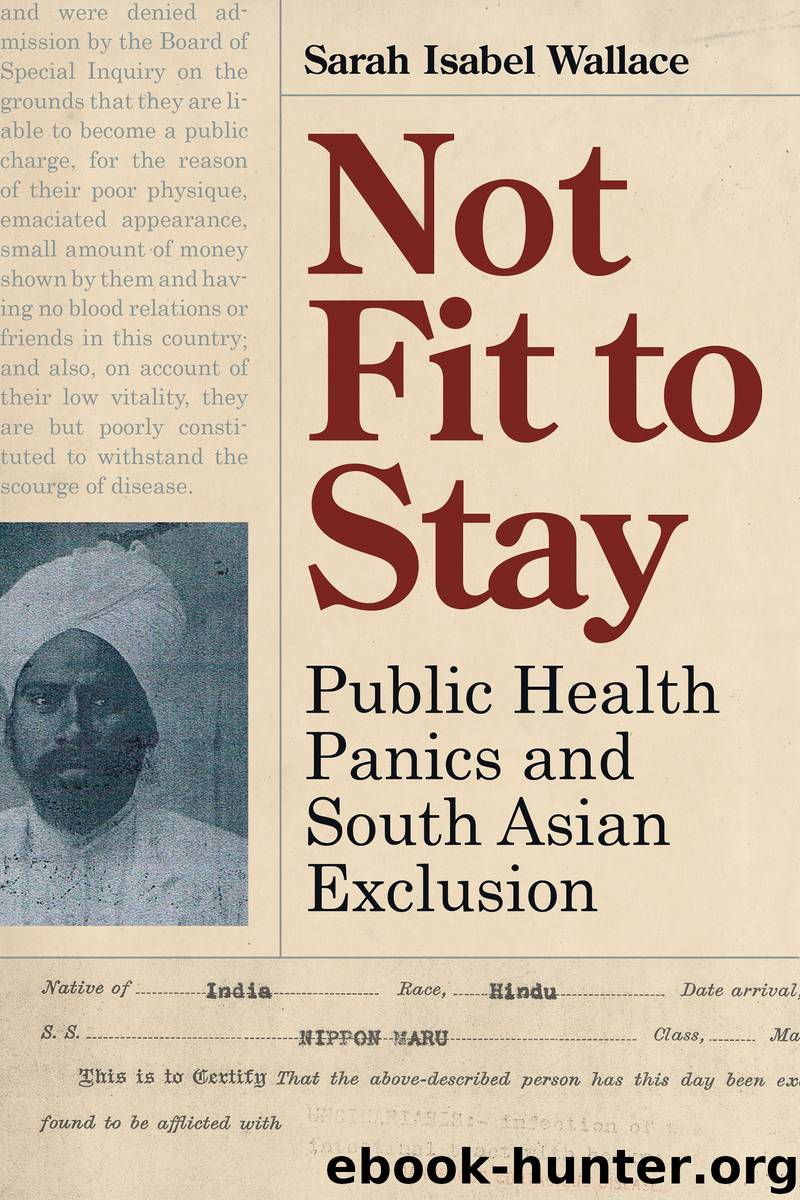
Author:Sarah Isabel Wallace
Language: eng
Format: epub
Publisher: UBC Press
Church’s lobbying on the Indian issue, which clearly drew heavily from the “Hindu disease” thesis, came to fruition in December, when the Senate passed a version of the Burnett bill that included the Indian Subcontinent within its Asian immigrant “barred zone.” The Act was in fact a compromise between those who wanted to explicitly exclude all Asian immigrants, and President Woodrow Wilson’s desire to keep Japanese nationals out of the legislation for reasons of diplomacy.109 When Wilson rejected the bill, the House and Senate passed it over his veto; thus, the Immigration Act of 1917 became law on February 5, 1917. Most Chinese immigration had been prohibited by the Chinese Exclusion Act of 1882; now, for the first time, South Asians and other Asians and Pacific Islanders were officially excluded. Japanese nationals, whose immigration was still governed by the 1907 Gentlemen’s Agreement, were exempt from this legislation, as were Filipinos. The Barred Zone provision of the 1917 legislation decisively ended Indian immigration, which in practice had ceased several years earlier, soon after the IS began barring the group by executive action. Seven years later, the “Asian Exclusion Act” provision of the Johnson–Reed Act would exclude India’s residents by name.
This chapter has shown how health-based anti-Indian logics and policies established early in the movement of South Asians to North America, including governments’ resort to hookworm screening, were employed to defend the propriety and legitimacy of South Asian exclusion. In Canada, the Department of the Interior used a 1912 report connecting South Asians with tuberculosis to justify the decision not to allow the families of resident South Asians to immigrate. Federal legislators also used health and eugenic arguments to defend the decision to reject the passengers of Komagata Maru in 1914. American observers of the Komagata Maru affair warned that it might threaten American executive exclusion and set a precedent for other Indians to increase their efforts to migrate to the continent; for this reason, US federal officials emphasized the urgent need for exclusionary legislation. Taking up the cause, congressional representatives from Washington State and California contended, like their counterparts in Canada, that South Asian health, living standards, and genetic stocks precluded their assimilation into Pacific coast society. Finally, Congress passed the 1917 Immigration Act, which designated South Asians as residents of a geographic area barred from immigrating to the United States. The following chapter will address the consequences of this legislation for South Asian rights in America. After first exploring how Canadian officials used health-based arguments to respond to South Asians’ requests for citizenship during and after the First World War, the focus will shift to the Pacific coast states, where, after legislative exclusion, American officials used similar reasoning to address the franchise issue in that country.
Download
This site does not store any files on its server. We only index and link to content provided by other sites. Please contact the content providers to delete copyright contents if any and email us, we'll remove relevant links or contents immediately.
The Vikings: Conquering England, France, and Ireland by Wernick Robert(84549)
Ali Pasha, Lion of Ioannina by Eugenia Russell & Eugenia Russell(40378)
The Conquerors (The Winning of America Series Book 3) by Eckert Allan W(38892)
The Vikings: Discoverers of a New World by Wernick Robert(37046)
Cecilia; Or, Memoirs of an Heiress — Volume 1 by Fanny Burney(32712)
Cecilia; Or, Memoirs of an Heiress — Volume 2 by Fanny Burney(32075)
Cecilia; Or, Memoirs of an Heiress — Volume 3 by Fanny Burney(32058)
Empire of the Sikhs by Patwant Singh(23189)
The Secret History by Donna Tartt(19443)
Hans Sturm: A Soldier's Odyssey on the Eastern Front by Gordon Williamson(18711)
Cat's cradle by Kurt Vonnegut(15538)
Pimp by Iceberg Slim(14778)
Sapiens: A Brief History of Humankind by Yuval Noah Harari(14546)
Norse Mythology by Gaiman Neil(13555)
Talking to Strangers by Malcolm Gladwell(13521)
Leonardo da Vinci by Walter Isaacson(13480)
4 3 2 1: A Novel by Paul Auster(12602)
Underground: A Human History of the Worlds Beneath Our Feet by Will Hunt(12223)
The Radium Girls by Kate Moore(12172)
